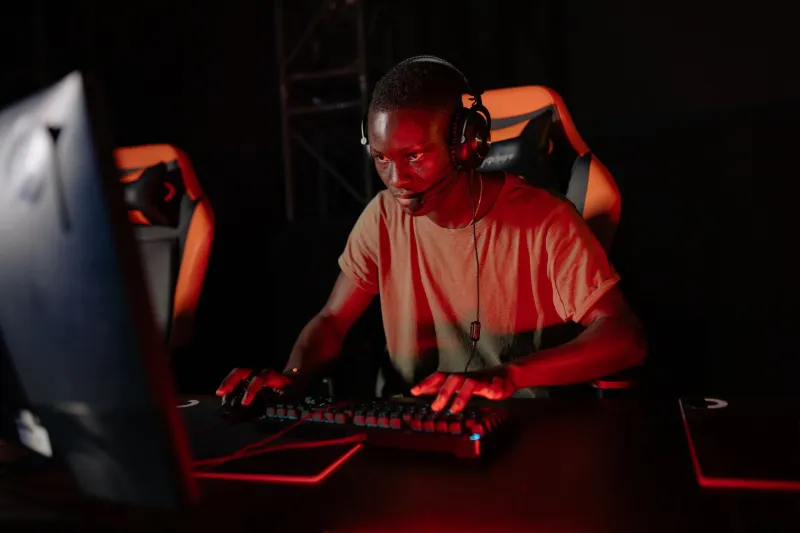
Read the Room, Kill the Round: The Cognitive Architecture Behind America's Most Dangerous Competitive Gamers
Watch a top-tier competitive player in real-time and the thing that jumps out first is the speed. Reactions that seem physically impossible. Decisions made before most people even register that a decision was needed. It looks like reflex. It looks like talent.
It's actually architecture.
The gap between a good player and an elite one isn't just mechanical. It's cognitive. The best competitors in American esports — the ones who consistently perform when the lobby is stacked and the stakes are real — have built, or in some cases were born with, a mental framework for processing chaotic information at a speed that gives them a structural advantage over everyone else in the server.
Understanding that framework doesn't just explain why they win. It's a blueprint.
The Three-Stage Loop That Elite Players Run Constantly
Dr. Samantha Reyes, a sports psychologist who has worked with collegiate and semi-professional esports athletes across several US programs, describes what she calls a "perception-decision-execution loop" that separates elite performers from average ones — not in kind, but in speed and accuracy.
"Every player is running this loop," she explains. "Scan the environment. Evaluate options. Act. The difference at the elite level is that the loop is compressed and the pattern library they're drawing from is enormous."
The scan phase is where most players lose time without realizing it. An average competitor looks at what's directly in front of them — the enemy they can see, the immediate threat. An elite player is scanning the entire available information space simultaneously: minimap, audio cues, crosshair placement of teammates, ability cooldowns, economy state, rotation timing, behavioral patterns from earlier in the match.
They're not thinking about all of it consciously. That's the key. Most of that information is being processed at a pre-conscious level — filtered, weighted, and surfaced only when it crosses a relevance threshold. The brain does the work before the player is aware it happened.
Pattern Recognition as a Competitive Weapon
One of the most consistent findings in performance psychology research is that expert decision-making is less about raw intelligence and more about pattern recognition — the ability to match a current situation to a stored template and retrieve the appropriate response almost instantaneously.
Chess grandmasters do this. Elite quarterbacks do this. And the best competitive gamers do it at a level that's genuinely remarkable.
"I don't think about what to do in most situations," said one professional Valorant player who asked to be identified only by his handle, Quillfire. "I've seen that situation so many times that my hands move before I've consciously decided anything. The decision already happened somewhere underneath."
This is what researchers call "chunking" — the mental compression of complex information sequences into single recognizable units. A beginner sees five separate pieces of information. An expert sees one pattern they've already solved a thousand times.
The competitive implication is significant. When the round goes sideways and chaos floods the screen, the average player experiences cognitive overload — too much information, not enough time, decision paralysis. The elite player's pattern library fires. They've been here before. They already know the move.
The Neurological Advantage You Can Actually Train
Here's where it gets practically useful: most of this is trainable. Not all of it — there are genuine individual differences in working memory capacity and processing speed that training can't fully close. But a substantial portion of what separates elite competitors from the pack is accumulated pattern exposure, and that's something you can deliberately build.
Dr. Reyes emphasizes what she calls "deliberate cognitive practice" — training sessions specifically designed to force rapid decision-making under incomplete information, rather than mechanical repetition of already-mastered mechanics.
"A lot of players grind mechanics. That matters. But the players who develop fastest cognitively are the ones putting themselves in situations where they have to think fast under pressure, regularly and intentionally," she says. "VOD review isn't just about seeing what you did wrong. It's about building pattern templates that your brain can access faster next time."
Elite players also tend to engage in what psychologists call "pre-cuing" — using early, incomplete information to begin narrowing the decision space before they need to act. Watching an opponent's crosshair angle before they peek. Tracking footstep audio to predict a push before it happens. The action hasn't occurred yet, but the pattern is already loading.
Pressure and the Cognitive Shutdown Problem
All of this breaks down under one condition: acute performance anxiety.
The psychophysiological stress response — elevated cortisol, narrowed attentional focus, increased heart rate — directly impairs the pre-conscious processing systems that elite players depend on. Under pressure, the scan phase contracts. The pattern library becomes harder to access. Players fall back on simpler, more rigid behaviors.
This is why clutch performance is a genuinely distinct skill set from baseline performance. Playing well in a low-stakes lobby is one thing. Accessing the same cognitive machinery when you're down one in the fifth map of a bracket final is another problem entirely.
The players who crack that problem — who can maintain cognitive fluidity when the stakes are highest — tend to have developed specific mental regulation techniques. Controlled breathing protocols to manage heart rate before a crucial round. Attention anchors that prevent the mind from spiraling into outcome thinking. Ritualized pre-action sequences that cue the brain back into execution mode.
"The goal isn't to eliminate the pressure response," Dr. Reyes notes. "It's to keep the processing architecture online while it's happening. The players who can do that are the ones you see making the right call in situations where everyone else would have frozen."
Building the Machine
The cognitive framework that produces elite competitive gaming performance isn't magic. It's constructed — through volume, deliberate practice, pattern exposure, and mental regulation work that most players never bother to invest in.
The gap between a player who's mechanically sharp and one who's genuinely dangerous is almost always cognitive. They're reading the game at a different resolution. They're operating from a larger, faster-loading library of solved problems. And when the pressure spikes, they've built the mental infrastructure to stay online.
That's the architecture. And it's available to anyone willing to build it.