Blank Mind, Full Send: The Mental Zone Elite FPS Players Tap Into Before a Clutch
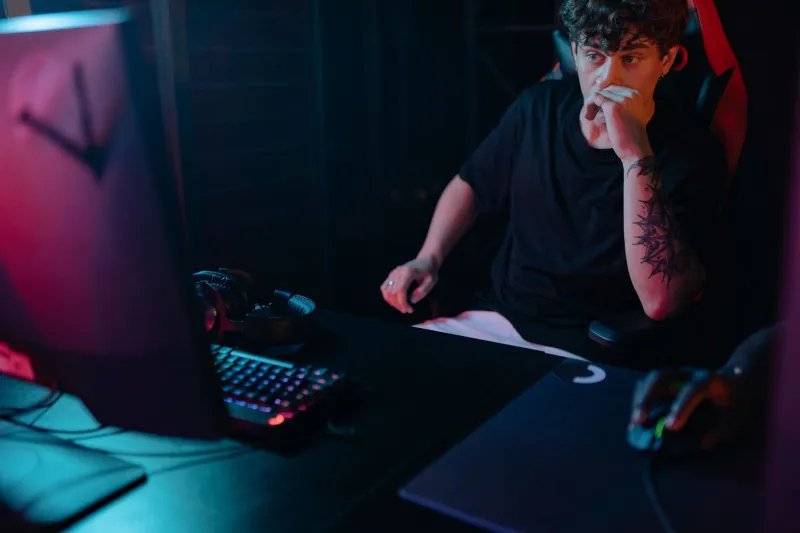
You've seen it on stream. The chat's going absolutely feral, the economy's wrecked, teammates are dead, and somehow the one guy left alive just... locks in. No panic typing in voice chat. No sighing. Just silence, crosshair placement, and a 1v4 that makes the whole lobby question reality.
That's not a highlight reel accident. That's the void stare in action.
What Even Is the "Void Stare"?
Competitive FPS players—from grinding Valorant ranked in their bedroom to stepping onto a LAN stage at a regional qualifier—describe a specific mental state that hits right before a high-stakes play. The language changes depending on who you ask, but the feeling is consistent: the noise drops out, time feels slower, and the game narrows down to just the next decision.
"It's like the chat disappears, my teammates' voices get quiet, and I'm just reading the mini-map and moving," says Marcus "Fraqline" Delgado, a semi-pro Valorant player out of Phoenix who's competed on the Challengers circuit. "I don't think about winning the round. I just play the round."
Sports psychologists call this a flow state—a concept popularized by Hungarian-American psychologist Mihaly Csikszentmihalyi. His research identified flow as a condition where a person is fully immersed in a challenging task, operating at the edge of their skill ceiling with minimal cognitive interference from self-doubt or external distraction. In simpler terms? Your brain stops second-guessing and starts executing.
But there's a specific flavor of flow that FPS players describe that goes a step further. It's not just focus—it's a kind of deliberate emptying. Less "I'm locked in" and more "I've let go."
The Science Behind Going Blank
Researchers studying esports performance have started paying serious attention to this phenomenon. A 2021 study published in the International Journal of Environmental Research and Public Health found that elite esports athletes displayed measurable differences in stress regulation and attentional control compared to casual players—particularly in high-stakes moments. The elite players didn't experience less pressure. They just processed it differently.
Part of what's happening is related to the prefrontal cortex, the part of your brain responsible for overthinking, second-guessing, and running worst-case scenarios. Under extreme pressure, some athletes experience what researchers call "transient hypofrontality"—a temporary reduction in prefrontal activity that allows the more automatic, trained parts of the brain to take over. It sounds counterintuitive. Less thinking leads to better performance. But if you've ever choked a clutch by overthinking your angles, you already know this is real.
Jordan "Stillwater" Haines, an amateur CS2 player from Atlanta who runs a mid-sized Twitch stream, describes it bluntly: "When I'm playing my best, I'm not really in my head at all. The second I start thinking 'okay, he's probably here, I should peek this way'—I'm already too slow. The good plays happen before I can narrate them."
Why Carry Players Get There More Often
Here's the uncomfortable truth: the void stare isn't equally available to everyone. It's not a personality trait. It's a skill that gets built through specific kinds of practice and mental conditioning.
Players who clutch consistently share a few common habits that prime their nervous system to drop into flow faster:
Deliberate exposure to pressure. Grinding ranked isn't enough. The players who enter the void reliably tend to seek out uncomfortable situations—scrimmaging against better teams, entering open qualifiers they're likely to lose, playing in environments where the stakes feel real. Repeated exposure to high-pressure moments desensitizes the threat response, making it easier to stay regulated when it counts.
Pre-round rituals. It sounds small, but the consistency matters. Whether it's a specific breathing pattern, a physical gesture, or a mental phrase repeated before a buy phase, rituals signal to the nervous system that it's time to shift modes. Sports psychologists call these "pre-performance routines," and the research on their effectiveness in traditional sports—basketball free throws, baseball at-bats—translates directly to competitive gaming.
Outcome detachment during play. This one's the hardest to sell to competitive players, but it's critical. The best clutch players aren't thinking about whether they win the round while they're playing the round. They're thinking about the next five seconds. Fraqline puts it this way: "If I'm thinking about the scoreboard, I've already lost the 1v3. I only think about the guy I'm about to kill."
How to Build Your Own Void
You don't need to be on a Challengers roster to develop this. Here are practical techniques grounded in both sports psychology and what real competitive players actually use:
Box breathing before rounds. Four counts in, four counts hold, four counts out, four counts hold. Do this during the buy phase on rounds that matter. It directly activates the parasympathetic nervous system and dials down cortisol. Simple, free, and it works.
Build a reset cue. Pick a physical anchor—pressing your thumb and index finger together, tapping the desk twice, whatever feels natural. Practice it during low-stakes gameplay paired with a moment of intentional calm. Over time, the cue starts to trigger the mental state automatically. Athletes call this "anchoring" and it's used everywhere from the NFL to Olympic shooting.
Replay your clutches, not just your mistakes. Most grinders VOD review their deaths and losses. That's valuable. But watching your own best moments—specifically the ones where you were in flow—reinforces the neural pathways associated with that state and makes it easier to access under pressure.
Play in silence sometimes. Not always, but deliberately. Strip away the music, the background noise, the podcast. Train your brain to operate in actual quiet so that when chaos hits in a match, silence becomes something you can create internally.
The Void Is a Skill, Not a Gift
The players who look ice-cold in a 1v5 didn't just wake up wired that way. They built something—through reps, through losing, through learning how to get out of their own heads at the exact moment it matters most.
The void stare isn't mystical. It's the result of a brain that's been trained to trust itself. And in the KillVoid universe, that's the whole game—owning the chaos so completely that the chaos stops being a threat and starts being your advantage.
Next time you're the last one alive and the round clock is ticking, don't try harder. Try less. Let the void in. That's where the clutch lives.